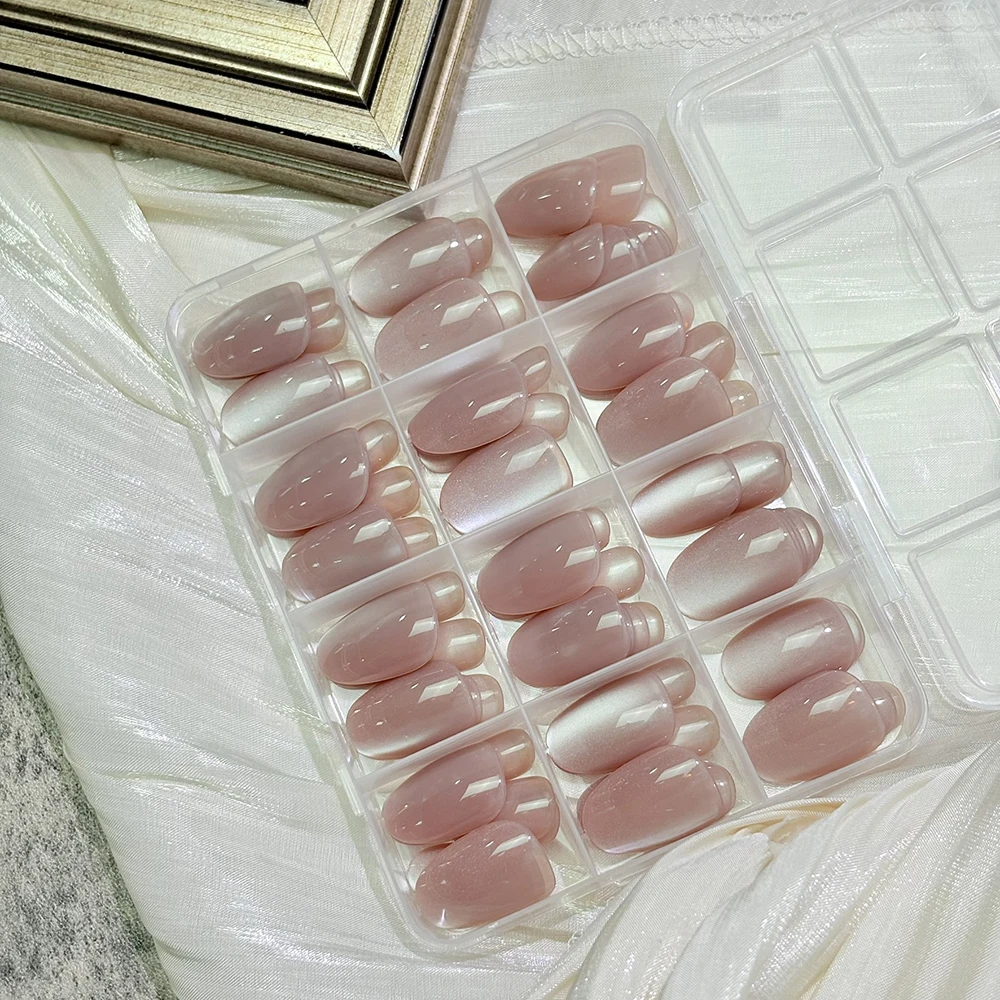
Press-on nail curvature is the side-to-side arch of the artificial nail. A press-on can be the correct width and still fit poorly if that arch is much deeper or flatter than your natural nail. The easiest way to spot the difference is to dry-fit the nail before adhesive and watch where it touches first.
Use this guide as the curvature hub for Eazie Nails. If the problem turns out to be width, cuticle alignment or overall size instead, move to the linked fit guides rather than trying to solve every issue with more adhesive.
Curvature and width are two different fit questions
Width asks whether the press-on covers the natural nail from sidewall to sidewall without resting on skin. Curvature asks whether the shell follows the natural nail’s arch closely enough to sit down without rocking, pinching or leaving a large gap.
A wider nail does not automatically solve a curvature mismatch, and a deeper curve does not automatically solve exposed sidewalls. Check both separately.
| What you notice | Likely question to check next |
|---|---|
| Natural nail is exposed at one or both sides. | Width or centering. See sidewall coverage. |
| The press-on overlaps skin. | Width. Compare a smaller size before changing curves. |
| The sides touch but the center sits high. | The press-on may be too curved for that nail. |
| The middle touches while the sides hover. | The press-on may be too flat for that nail. |
| Pressing one side makes the opposite side lift. | Curvature or poor centering; retest without adhesive. |
Use a dry fit before adhesive
- Center the press-on. Line up the nail with the natural nail rather than judging it while it is tilted to one side.
- Set it down lightly. Do not squeeze the shell into place. Hard pressure can hide the gap you are trying to diagnose.
- Look from the fingertip. Check the center and both side edges. A low angle makes the arch easier to see.
- Press gently in the center. Notice whether the nail stays stable or rocks from side to side.
- Compare one nearby size or mold. Change one variable at a time so you can tell whether width or curve actually improved.
The broader How Should Press-On Nails Fit? guide combines this curvature check with sidewalls, cuticle placement and comfort.
If the press-on is too curved
A deeply arched press-on can touch along the side edges while leaving more space through the middle of a flatter natural nail. You may also feel that the piece only looks flush when you squeeze it downward.
Do not plan to clamp a visibly mismatched shell into place with adhesive. Compare another mold or collection with a shallower profile instead. The dedicated guide explains how to tell if a press-on is too curved.
If the press-on is too flat
A flatter shell can contact the center of a more arched natural nail while the side edges sit away from the nail. Sizing up may add width without fixing that profile difference.
Read how a too-flat press-on behaves before deciding that the problem is simply size.
Rocking is useful information
If a loose press-on pivots when you press one side, stop and look at the full fit. Rocking can come from a curve mismatch, off-center placement or a piece that is too narrow to sit stably.
Retest the same finger with the next plausible size and, when possible, a different mold. If both widths rock in the same pattern, curvature becomes a stronger suspect.
Curvature can vary from finger to finger
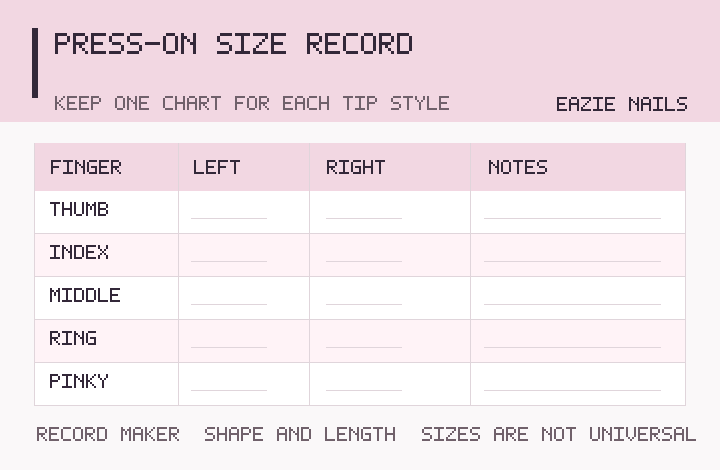
Your thumbs do not have to match your index fingers, and the same finger on the opposite hand may not be identical. That is why a ten-finger record is more useful than assuming one five-size pattern applies to both hands.
For custom or made-to-order sets, a physical sample can help you compare the actual profile before committing to a full set. See how to use a press-on nail sizing kit.
Do not confuse fit with attachment
Adhesive is meant to secure a compatible nail, not correct a large structural mismatch. If the shell visibly rocks, pinches or gaps before adhesive, solve the fit question first.
Once the piece sits naturally, continue with the product’s actual preparation and attachment directions.
Quick curvature checklist
- The nail covers the natural nail without sitting on surrounding skin.
- The center and side edges make reasonably even contact during a light dry fit.
- The piece does not rock when touched gently.
- You do not need strong pressure to make it look flush.
- The fit is comfortable before adhesive.
For the complete sequence, use Find Your Fit, the measurement guide, and the main press-on fit checklist.
The conversation